
Essential Question: How will you work with partners to advocate for systemic change that advances equitable, anti-racist, and inclusive school communities?
Portrait of a Teacher-Researcher
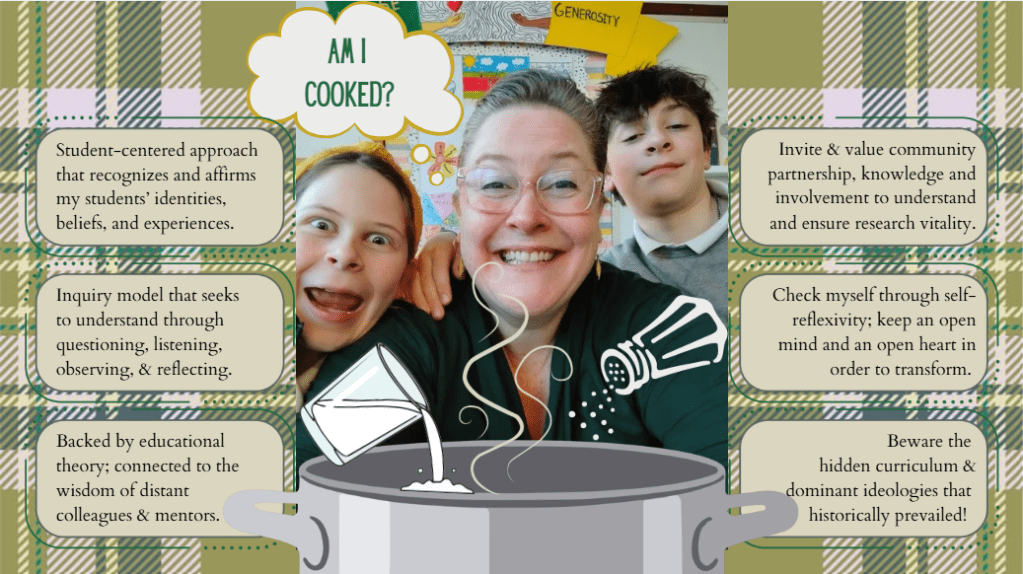
One way we show love in my family is through homecooked meals and memories formed around the family table. When I think about myself as a teacher and advocate within the educational sphere, I think about the sense of community formed over a shared meal. Teaching is a lot like cooking – it requires intention, experimentation, and continual adjustment. The “ingredients” I put into the recipe of my teaching practice are all necessary to create a composed dish or shared learning experience.
At the center are my students. I believe that students’ identities, experiences, and voices must be affirmed in the classroom to understand how schools can better serve them. Through inquiry – asking questions, listening deeply, observing, and reflecting – I work to understand my students deeply. This understanding becomes the foundation for advocating for practices and structures that honor student agency and support equitable literacy development.
My approach is grounded in both educational theory and the shared wisdom of colleagues, mentors, families, and my professional community. I see advocacy as inherently collaborative – meaningful, lasting change requires partnership. By engaging with students, families, colleagues, and my Seattle University cohort, I am better able to challenge inequities and contribute to more inclusive, responsive learning environments.
This work also demands self-reflexivity. In order to advocate for systemic change, I must continually examine my own biases, assumptions, and positionality. Transformation begins with a willingness to question myself, as well as the hidden curricula and dominant ideologies that have historically shaped schooling in inequitable ways.
Ultimately, this image reflects my belief that advocacy is not separate from teaching it is embedded within it. Each instructional choice, each moment of listening, and each act of reflection contributes to a larger effort to create schools that are more just, inclusive, and responsive to all learners.
Like any complex recipe, this work is not always perfectly balanced. As a mom and a teacher, I sometimes wonder (to steal a phrase from my students), “Am I cooked?” Yet, through this ongoing process of adjustment and growth, meaningful change becomes possible. Through partnerships with my students, their families, my colleagues, and the broader community, this work becomes a shared recipe – one that makes true advocacy for equity in schools possible.
Advocating for Ethnic Studies: A Vision for My School Community
As an ELA teacher, I care deeply about the texts I bring into my classroom. I want my students to see themselves reflected in the literature we study, while also engaging with stories that expand their understanding of diverse cultural experiences and ways of knowing. I believe that through reading and studying the world, we learn to live with greater empathy, unity, and peace. For this reason, I see curriculum design as an essential site of advocacy – one where representation, identity, and voice must be intentionally centered.
This belief connects directly to my understanding of Ethnic Studies. When rooted in students’ identities and experiences, and strengthened through partnerships with families and cultural experts, Ethnic Studies makes learning more relevant and meaningful to students’ lives. Through diverse and inclusive learning experiences, students are better prepared to navigate and contribute to the beautiful complexity of the world around them.
The presentation shared below is an example of work I completed for my Ethnic Studies course at Seattle University. As the only fully asynchronous and self-paced course in the program, it required a high level of independence, reflection, and self-direction. In this project, I was tasked with imagining what it might look like to assess and redesign my school’s curriculum to incorporate Ethnic Studies. While this is not a proposal I have formally presented, it reflects my growing capacity to think critically about systems, identify areas for growth, and envision pathways toward more equitable and inclusive school communities.
If I were to move forward with this work within my school, I would begin by building partnerships with colleagues, families, and community experts. I do not see this work as something that can or should be done in isolation. Meaningful and sustainable change requires a collaborative approach – one that brings together a diversity of perspectives, experiences, and expertise. By engaging in a critical community, I would seek to ensure that any Ethnic Studies initiative is responsive, inclusive, and rooted in the lived realities of the students and families it aims to serve.
References
- Bloomekatz, A. (2019). Victory for Mexican American studies in Arizona: An interview with Curtis Acosta. In R. T. Cuauhtin, M. Zavala, C. Sleeter, & W. Au (Eds.), Rethinking ethnic studies (pp. 341–346). Rethinking Schools.
- Giroux, H. A., & Penna, A. N. (1979). Social education in the classroom: The dynamics of the hidden curriculum
- Download Social education in the classroom: The dynamics of the hidden curriculum. Theory & Research in Social Education, 7(1), 21-42.
- Muhammad, G. (2023). Unearthing joy: A guide to culturally and historically responsive teaching and learning. Scholastic Inc.
- Phillips, D. K., & Carr, K. (2014). Becoming a teacher through action research: Process, context, and self-study. Routledge.
- United States Conference of Catholic Bishops. (n.d.). 1 Corinthians 12. Retrieved October 25, 2025, from https://bible.usccb.org/bible/1corinthians/12

