
Essential Question: How will you facilitate an inclusive and culturally sustaining learning community in your classroom that fosters a sense of belonging and agency for each student?
Bringing It All Together
Throughout the MTTL program, I developed a deepened understanding that learning environments are shaped not only by classroom routines, procedures, and academic expectations, but also by the relationships, care, inclusivity, and sense of belonging cultivated within them. I selected this essay as an artifact of my learning because culturally responsive care has become one of the foundational philosophies of my teaching practice. In both my coursework and my lived experiences as an educator, I have seen that students learn best when they feel safe, known, valued, and affirmed in bringing their full identities into the classroom. This essay reflects my growing understanding that equitable learning environments must center students’ identities, lived experiences, cultural knowledge, and diverse learning needs.
Building Teacher-Student Relationships
I believe that building affirming relationships with students is one of the most important aspects of teaching. Learning requires vulnerability. It asks students to take risks, try new things, and persevere through challenges on the path toward growth and mastery. In order to take these risks, students need to know that they are valued, respected, and supported by the adults around them.
One way I cultivate belonging is by taking time to deeply know my students. Early in the MTTL program, I interviewed several students to learn more about their identities, interests, backgrounds, passions, and experiences. I then created artistic representations of what I learned from each conversation. The creative process encouraged me to think about each student from new perspectives and to reflect on the unique brilliance they brought into our classroom community.
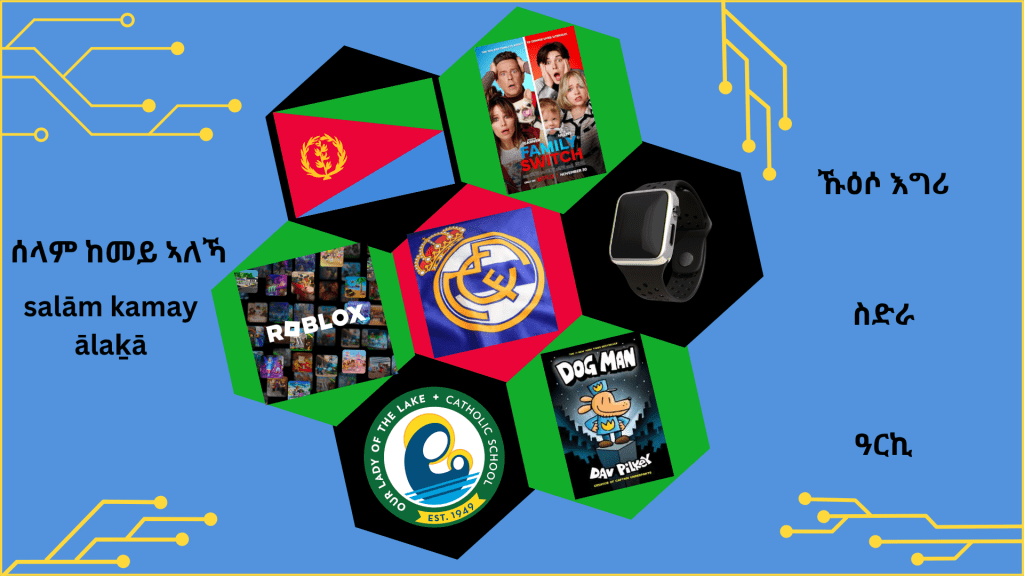
One student proudly shared connections to his Eritrean culture, his love of soccer, and some of his favorite hobbies. His portrait incorporated words and phrases in his home language, Tigrinya, alongside a geometric design inspired by a soccer ball.
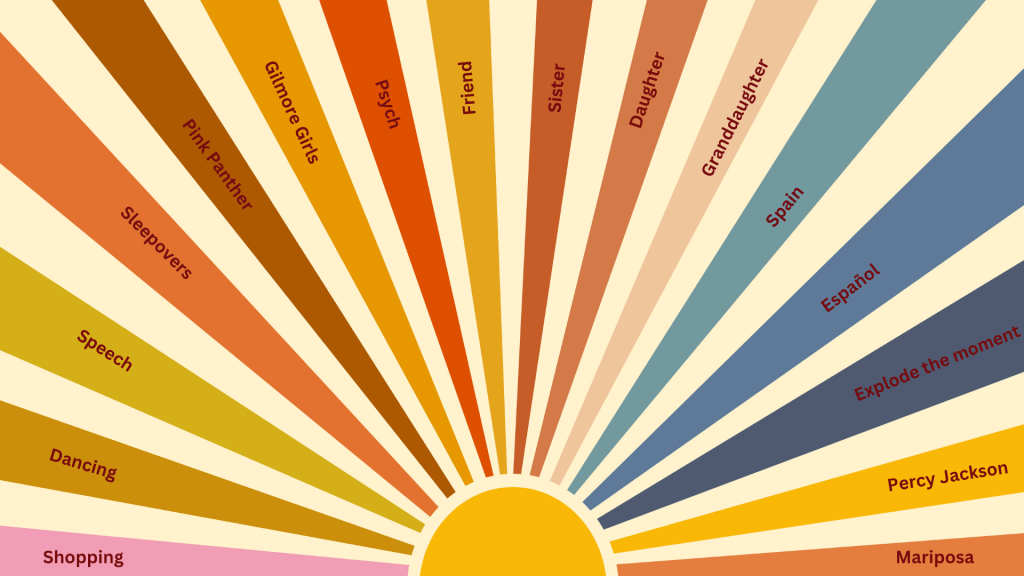
Another student spoke animatedly about her family, friendships, and favorite activities. Her joy and energy reminded me of a burst of sunlight, and I represented this through sunbeams extending across the image, each containing a word that harkened back to our conversation.
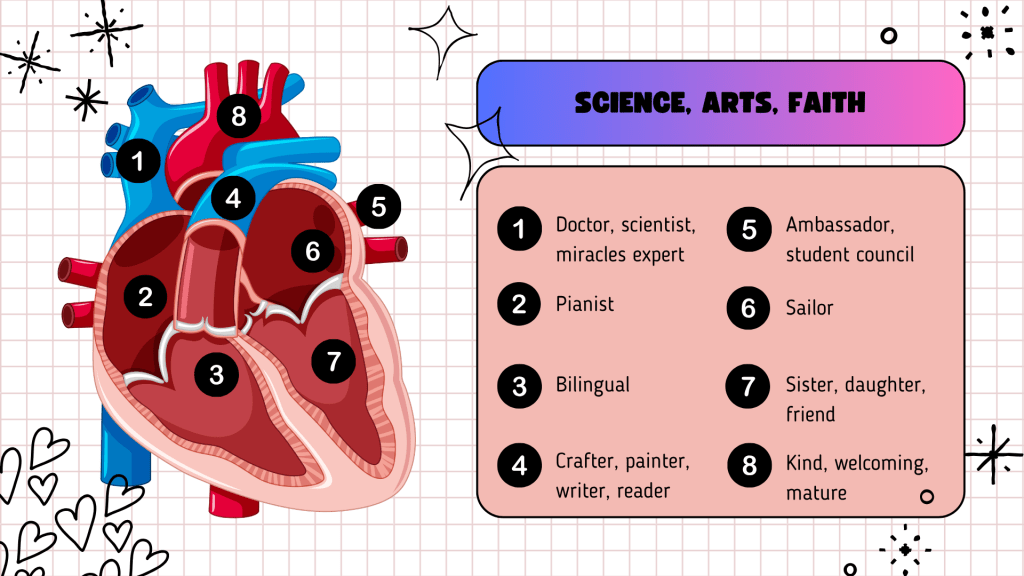
A third student described her identity, passions, faith, and her dream of one day working as a scientist for the Vatican, investigating miracles. Inspired by her interests in science, faith, as well as her particular blend of heart and intellectualism, I represented her interview through a diagram of an anatomical heart.
This artifact reminds me of the importance of listening to our students, valuing their unique brilliance, and building affirming teacher-student relationships. When we take time to listen deeply and understand who our students are, we create learning environments where students feel known, valued, and loved.
Building Collaborative Classroom Communities
Through my studies and classroom experiences, I learned that meaningful collaboration does not happen automatically; students must be explicitly taught how to work together in ways that foster inclusion, equity, accountability, and shared responsibility. Cohen and Lotan’s (2014) Designing Groupwork: Strategies for the Heterogeneous Classroom was particularly influential in shaping my understanding of collaborative learning and groupworthy tasks. Cohen and Lotan explain that effective groupwork should create positive interdependence among group members, provide opportunities for equal-status participation, and allow students to contribute through multiple intellectual strengths and social abilities.
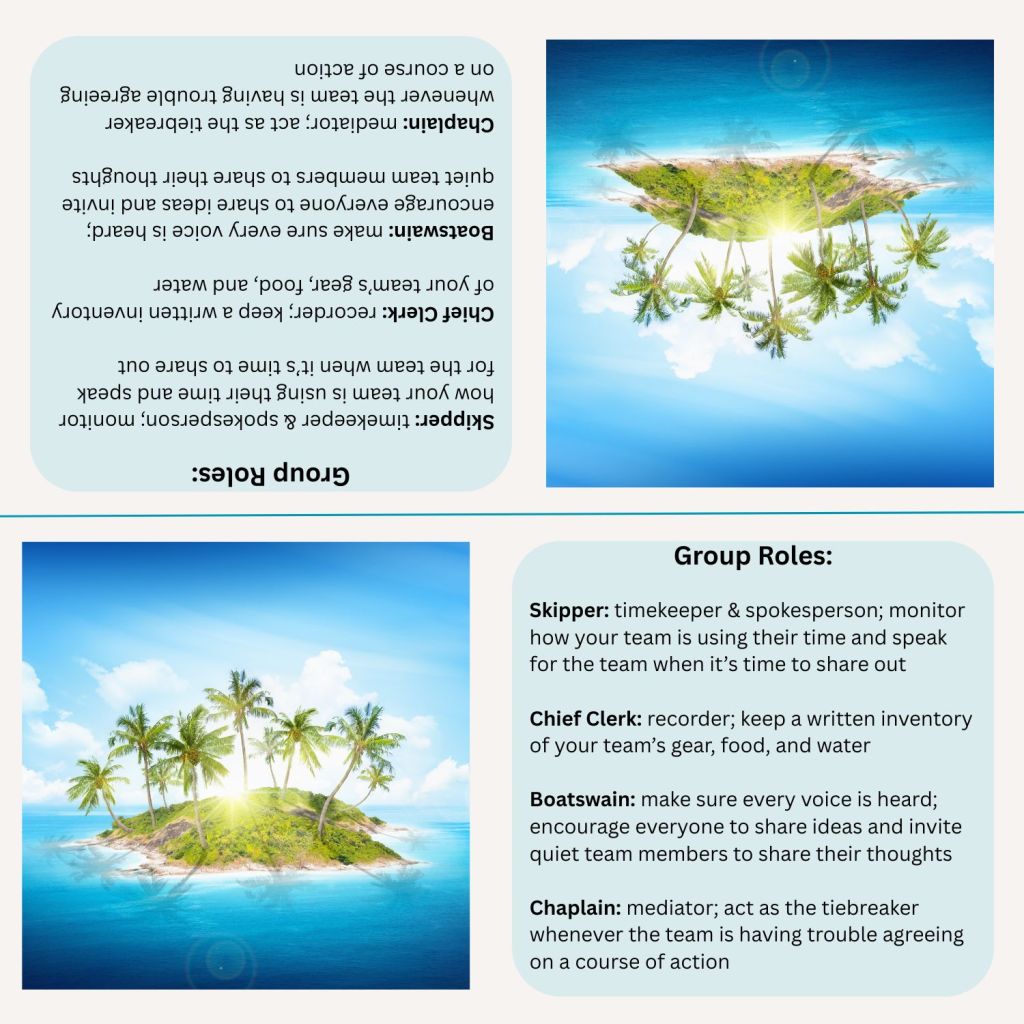
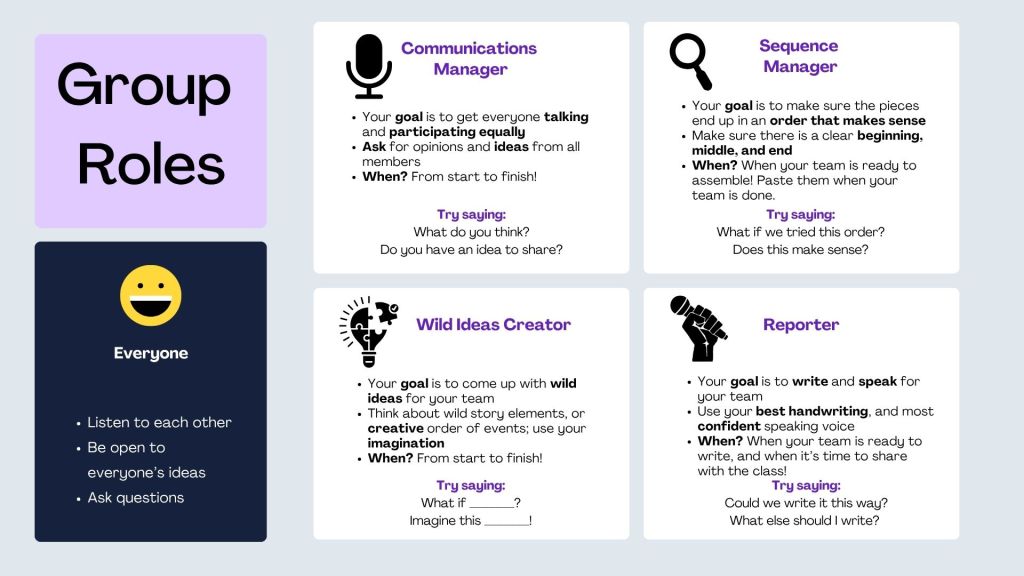
These artifacts are examples of group role structures I designed to support inclusive and collaborative learning environments within my classroom. Rather than assigning generic group jobs, I intentionally designed roles specific to each learning task in order to help students understand how they could meaningfully contribute to their team’s success. For example, the “desert island” and ship-themed table tent was created for a collaborative anticipatory set in which students imagined they had been stranded together and needed to cooperatively solve a series of challenges. Students selected roles based on their strengths and interests, allowing them to establish a sense of agency and responsibility within the group from the outset.
These structures reflect my belief that equitable learning environments require intentional instructional design that supports every student in feeling valued, heard, and capable of contributing meaningfully to the classroom community. By providing clear expectations, collaborative scaffolds, and opportunities for shared problem-solving, I strive to create learning spaces where students experience belonging, agency, and authentic intellectual engagement.
Group Roles Table Tent
Group Roles Task Card
References
- Berger, R., Woodfin, L., & Vilen, A. (2016). Learning that lasts. Jossey-Bass.
- Cohen, E. G., & Lotan, R. A. (2014). Designing groupwork: Strategies for the heterogeneous classroom (3rd ed.). Teachers College Press.
- Darling-Hammond, L., Flook, L., Cook-Harvey, C., Barron, B., & Osher, D. (2020). Implications for educational practice of the science of learning and development. Applied Developmental Science, 24(2), 97–140. https://doi.org/10.1080/10888691.2018.1537791
- McMillan, J. H. (2018). Classroom assessment: Principles and practice that enhance student learning and motivation (7th ed.). Pearson.
- Wiggins, G., & McTighe, J. (2005). Understanding by design (Expanded 2nd ed.). Association for Supervision and Curriculum Development.

